How to Choose the Right Ethernet Cable for Your Network?
srijeda , 25.01.2017.To build your Ethernet network, the transmission media Ethernet cable is indispensable. And there are a variety of choices for Ethernet cables, such as Cat5e, Cat6, Cat6a and so on. If you are familiar with the differences between these different types of Ethernet cables, you may think it’s very simple to choose the right Ethernet cable for your network. However, is this really enough to help you make the decision? Are there any other factors you have to take into consideration? This article will give you the answer.
First, let’s have a quick review of the basic knowledge of these different types of Ethernet cables. For data speed, Cat5e is designed to support 1 Gigabit Ethernet with bandwidth up to 100MHz; Cat6 can support higher data rate of 10 Gigabit Ethernet with bandwidth up to 250 MHz; Cat6a is defined at frequencies up to 500MHz among 10G Ethernet applications. For transmission distance, Cat5e can reach 100 meters at the speed of 1Gbps; Cat6 is able to run 100 meters with data speed up to 1Gbps and only 55 meters at the speed of 10Gbps; Cat6a can support the distance over 100 meters at the speed of 10Gbps. Which types of Ethernet cables to choose depends on your requirement for transmission speed and distance. After you make a decision on this, there are some other factors you have to consider—straight-through or crossover cable, UTP (unshielded twisted pair) or STP (shielded twisted pair) cable, length and color. The following part will focus on these factors.
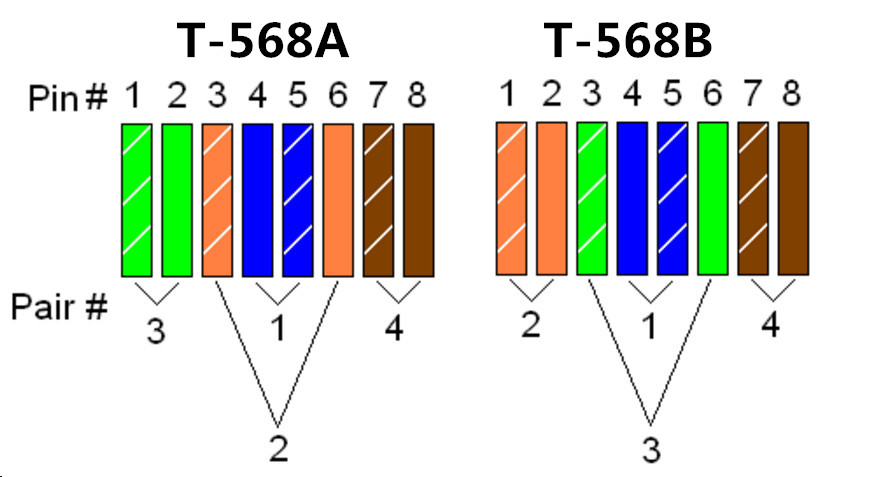
Ethernet cable terminated with RJ45 connector contains eight color-coded wires. The color-coded wiring sequences exist as a cabling industry standard. When linking RJ45 connector to a cable, there are two wiring standards—T-568A and T-568B. The two wiring standards are used to create a straight-through cable (T-568A or T-568B on both ends), or a crossover cable (T-568A on one end and T-568B on the other end). To choose a straight-through cable, you have to use either T-568A or T-568B on both ends of the cable; to choose a crossover cable, you need to wire T-568A on one end and T-568B on the other end of the cable. Here is a figure of T-568A and T-568B, from which you can see the difference between these two wiring standards.
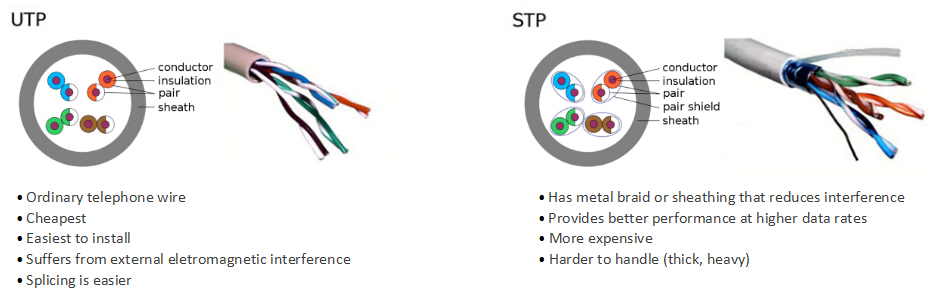
STP cable has a metal shield around each twisted pair which is composed of copper tape, a layer of conducting polymer or a braid (mostly made of copper or aluminum). With the shield, EMI (electromagnetic interference) and crosstalk can be greatly reduced, which enables the high performance of data transmission between different devices. While UTP cable has no shielding. It is designed to cancel electromagnetic interference through the way the pairs are twisted inside the cable. If the Ethernet cable runs in the environment where the interference or crosstalk is not the main concern, it is suggested to choose UTP cables which are lower in cost. But if the environment is full of powerful magnetic fields which may have an influence on the performance of network, STP cable is absolutely the optimal choice. To have a better understanding of the difference between UTP cable and STP cable, here is figure of the inner structure of UTP cable and STP cable.
When choosing Ether cable for your network, you also need to consider length and color. Ethernet cable comes in standard lengths such as 1, 3, 5, 7, and 10 meter. Longer lengths are available, such as bulk Cat5e cable 305m. The distance between your various network devices and your network switch or router will determine the length you need. In addition, Ethernet cable is designed in all sorts of colors, such as blue, gray, red and some other color. This decision can be based purely on your individual taste and preference.
There is no doubt that choosing the right Ethernet cable can make your network work at a high performance level. I hope this article can help you know more about Ethernet cable and make the right choice for your network application. There are different types of Ethernet cables available in FS.COM, such as UTP Cat5e bulk cable, STP Cat6 bulk cable and so on. Also, they provide different types of RJ45 couplers which can be a convenient way to combine two short Ethernet cables into a longer one, such as Cat6 coupler and Cat5e coupler.
Oznake: Cat5e bulk cable, cat5e cable 305m, Ethernet cable, RJ45 Coupler, UTP Cable, STP Cable, straight-through cable, crossover cable
komentiraj (0) * ispiši * #
UTP Cable vs. STP Cable
četvrtak , 19.01.2017.It is well known that twisted pair cable consists of a pair of insulated wires twisted together, which is widely used for Ethernet cable. In general, there are several types of twisted pair cables, such as, UTP (unshielded twisted pair) cable, STP (shielded twisted pair) cable, SSTP (screened shielded twisted pair) and FTP (foil twisted pair). Among these cables, UTP and STP are the two most commonly used cables which occupy the majority of the market. Are you familiar with UTP cable and STP cable? What is the difference between UTP and STP cables? Which one is better? If you don't have enough knowledge of these two kinds of cables, you may feel confused when you plan to buy bulk Ethernet cables. As it is necessary to make a choice between UTP and STP cables for deploying the network, this article is going to introduce these two kinds of twisted pair cables in details, seeking the answer.
From its name, it is easy to learn that UTP cable has no shielding. Considering that the shielding feature is mainly designed to reduce Electromagnetic Interference (EMI), does the UTP cable have this function if put into use? In fact, UTP cable reduces the interference directly through the twisted pairs inside the cable. Furthermore, without shielding, UTP cable is thinner, lighter, more flexible and more durable than STP cable, which makes cable installation easier, especially in limited space. In addition, not relying on an outer shield, less money will be spent on the maintenance of UTP cable, which is beneficial to save the investment on installation and maintenance. To better understand the inner structure of UTP cable, here is a figure for you.

STP cable has a metal shield around each twisted pair which is composed of copper tape, a layer of conducting polymer or a braid (made of copper or aluminum mostly). The shield can be applied to each pair of the cable or to all pairs together. With the shield, EMI can be greatly reduced, which enables the high performance of data transmission between different devices. Also, the crosstalk can be efficiently prevented by the shield, which exists among the wires inside the cable. However, the shield of STP cable is quite fragile and rigid. If the shield suffers damage, the cabling system is likely to be affected by interference. Therefore, it is necessary to pay much attention to the installation and maintenance of STP cable. You can learn more about the structure of STP cable from the figure below.

Due to different characteristics, the two kinds of cables are used in different environment.
STP cables are often used in high EMI environment where interference is a risk. For example, airports, hospitals and factories usually have lots of machines that can produce interference, so it would be more beneficial to apply STP cables. And STP cables are also useful when cables are surrounded by fluorescent lights, microwave ovens, powerful motors and other equipment with larger electromagnetic interference.
UTP cables are typically used in offices and homes. If the interference or crosstalk is not the main concern, it is suggested to choose UTP cables which are lower in cost. But if the environment is full of powerful magnetic fields which may have an influence on the performance of network, STP cables are absolutely the optimal choice.
After discussion, we can learn that UTP cable is cheaper, easier to install and more suitable for environment with low EMI; while STP has a stronger ability for anti-interference and needs careful maintenance. If the place you deploy network has high EMI, STP cable is highly recommended; if the EMI is not a risk, you are suggested to choose UTP cable which is lower in cost. I hope this article can help you choose the suitable Ethernet cable. There are different types of Ethernet cables available in FS.COM, such as UTP bulk cat5e cable, STP bulk cat6 cable, UTP cat6a bulk cable, STP cat7 bulk cable and so on.
Oznake: UTP Cable, STP Cable, bulk ethernet cable, bulk cat5e cable, bulk cat6 cable
komentiraj (0) * ispiši * #
