Do Not Look Down Upon Cable Tie
subota , 28.01.2017.It goes without saying that cable management is an essential step for the whole cabling system. When carrying on cable management, there is a small component—cable tie, which is easily ignored by many people. As a matter of fact, the role of cable tie in cable management is as important as that of Phillips screwdriver in tool bag. The figure below shows the neat and tidy cabling system with the use of cable ties. So do not look down upon cable tie. This article will guide you to know more about cable tie from its applications, advantages as well as factors to consider when choosing cable ties.

Because cable tie is low in cost and easy to use, it has been used in a wide range of applications. Followings are five common applications of cable tie.
Application one: Cable tie can be used to bundle cables firmly. You can make minute adjustments on the cable tie to realize bundling cables with different sizes.
Application two: Cable tie can be used to organize cable bundles. In addition, cable tie with an outside flag design is helpful to separate and identify different cables.
Application three: Cable tie can be used as clip for holding cables, tubing and hoses. And cable tie can do this well in limited space.
Application four: Cable tie made of special material with high performance can be used in hash environment where cables have to be exposed to high temperature, UV rays, rain, salt water and so on.
Application five: Cable tie can also be used in household applications, such as placing and fixing tools in the garage.
Cable tie obtains several advantages that help to achieve successful cable management.
Avoid injury: Keeping bundled cables affixed to server racks or hangers helps data center managers avoid being hurt like tripping, which would cause body injury.
Protect cables: Cable tie can protect cables from damage caused by excessive tension, keep the shape of cables, and guarantee the high performance of network.
Save money: Cable tie is low in cost which can save money for other investments on the cabling system.
Identify cables easily: With all the cables organized neatly, data center managers can identify and manage cables easily.
There are various types of cable ties available on the market, such as plastic cable tie, velcro cable tie, nylon cable tie, stainless steel zip tie and so on. And different types are designed to meet different requirements in the application. Therefore, it is necessary to take some factors into consideration when choosing cable ties.
Material: Cable ties are available in different materials with their own specific properties. In addition, the selection of material is directly related to the environment where cables runs. Cable ties made of some materials can be used in outdoor environment while others can be only used indoor.
Design: Cable ties have different designs of construction, such as self-locking, ID marker and so on. They can provide a convenient using way to satisfy different needs.
Length: The length of cable tie length should be longer than the diameter of the cable bundle. It cannot be too long or too short.
Although cable ties look inconspicuous, the importance of these cheap components can not be looked down upon. It can do an amazing job for making messy cables well-organized. Thus, it is greatly favored by data center managers. I hope this article can help you have a better understanding of cable ties and choose the suitable type of cable tie for your application. FS.COM provides the cable ties mentioned above and some other products for cable management, such as cable management panel.
Oznake: velcro cable tie, nylon cable ties, stainless steel zip ties, cable management panel
komentiraj (0) * ispiši * #
How to Choose the Right Ethernet Cable for Your Network?
srijeda , 25.01.2017.To build your Ethernet network, the transmission media Ethernet cable is indispensable. And there are a variety of choices for Ethernet cables, such as Cat5e, Cat6, Cat6a and so on. If you are familiar with the differences between these different types of Ethernet cables, you may think it’s very simple to choose the right Ethernet cable for your network. However, is this really enough to help you make the decision? Are there any other factors you have to take into consideration? This article will give you the answer.
First, let’s have a quick review of the basic knowledge of these different types of Ethernet cables. For data speed, Cat5e is designed to support 1 Gigabit Ethernet with bandwidth up to 100MHz; Cat6 can support higher data rate of 10 Gigabit Ethernet with bandwidth up to 250 MHz; Cat6a is defined at frequencies up to 500MHz among 10G Ethernet applications. For transmission distance, Cat5e can reach 100 meters at the speed of 1Gbps; Cat6 is able to run 100 meters with data speed up to 1Gbps and only 55 meters at the speed of 10Gbps; Cat6a can support the distance over 100 meters at the speed of 10Gbps. Which types of Ethernet cables to choose depends on your requirement for transmission speed and distance. After you make a decision on this, there are some other factors you have to consider—straight-through or crossover cable, UTP (unshielded twisted pair) or STP (shielded twisted pair) cable, length and color. The following part will focus on these factors.
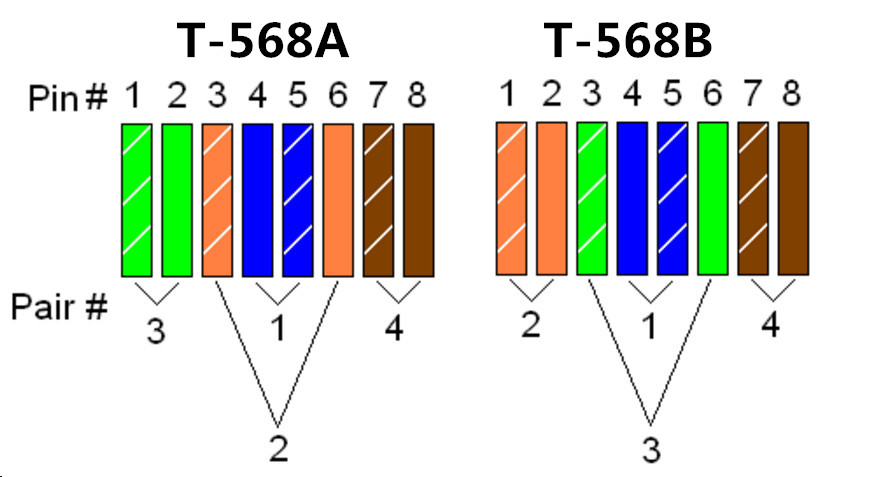
Ethernet cable terminated with RJ45 connector contains eight color-coded wires. The color-coded wiring sequences exist as a cabling industry standard. When linking RJ45 connector to a cable, there are two wiring standards—T-568A and T-568B. The two wiring standards are used to create a straight-through cable (T-568A or T-568B on both ends), or a crossover cable (T-568A on one end and T-568B on the other end). To choose a straight-through cable, you have to use either T-568A or T-568B on both ends of the cable; to choose a crossover cable, you need to wire T-568A on one end and T-568B on the other end of the cable. Here is a figure of T-568A and T-568B, from which you can see the difference between these two wiring standards.
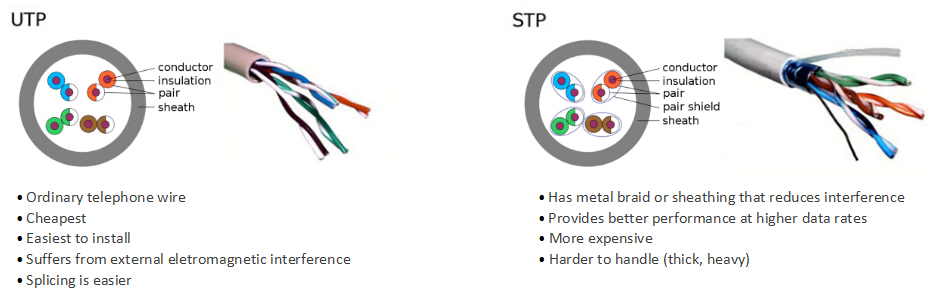
STP cable has a metal shield around each twisted pair which is composed of copper tape, a layer of conducting polymer or a braid (mostly made of copper or aluminum). With the shield, EMI (electromagnetic interference) and crosstalk can be greatly reduced, which enables the high performance of data transmission between different devices. While UTP cable has no shielding. It is designed to cancel electromagnetic interference through the way the pairs are twisted inside the cable. If the Ethernet cable runs in the environment where the interference or crosstalk is not the main concern, it is suggested to choose UTP cables which are lower in cost. But if the environment is full of powerful magnetic fields which may have an influence on the performance of network, STP cable is absolutely the optimal choice. To have a better understanding of the difference between UTP cable and STP cable, here is figure of the inner structure of UTP cable and STP cable.
When choosing Ether cable for your network, you also need to consider length and color. Ethernet cable comes in standard lengths such as 1, 3, 5, 7, and 10 meter. Longer lengths are available, such as bulk Cat5e cable 305m. The distance between your various network devices and your network switch or router will determine the length you need. In addition, Ethernet cable is designed in all sorts of colors, such as blue, gray, red and some other color. This decision can be based purely on your individual taste and preference.
There is no doubt that choosing the right Ethernet cable can make your network work at a high performance level. I hope this article can help you know more about Ethernet cable and make the right choice for your network application. There are different types of Ethernet cables available in FS.COM, such as UTP Cat5e bulk cable, STP Cat6 bulk cable and so on. Also, they provide different types of RJ45 couplers which can be a convenient way to combine two short Ethernet cables into a longer one, such as Cat6 coupler and Cat5e coupler.
Oznake: Cat5e bulk cable, cat5e cable 305m, Ethernet cable, RJ45 Coupler, UTP Cable, STP Cable, straight-through cable, crossover cable
komentiraj (0) * ispiši * #
UTP Cable vs. STP Cable
četvrtak , 19.01.2017.It is well known that twisted pair cable consists of a pair of insulated wires twisted together, which is widely used for Ethernet cable. In general, there are several types of twisted pair cables, such as, UTP (unshielded twisted pair) cable, STP (shielded twisted pair) cable, SSTP (screened shielded twisted pair) and FTP (foil twisted pair). Among these cables, UTP and STP are the two most commonly used cables which occupy the majority of the market. Are you familiar with UTP cable and STP cable? What is the difference between UTP and STP cables? Which one is better? If you don't have enough knowledge of these two kinds of cables, you may feel confused when you plan to buy bulk Ethernet cables. As it is necessary to make a choice between UTP and STP cables for deploying the network, this article is going to introduce these two kinds of twisted pair cables in details, seeking the answer.
From its name, it is easy to learn that UTP cable has no shielding. Considering that the shielding feature is mainly designed to reduce Electromagnetic Interference (EMI), does the UTP cable have this function if put into use? In fact, UTP cable reduces the interference directly through the twisted pairs inside the cable. Furthermore, without shielding, UTP cable is thinner, lighter, more flexible and more durable than STP cable, which makes cable installation easier, especially in limited space. In addition, not relying on an outer shield, less money will be spent on the maintenance of UTP cable, which is beneficial to save the investment on installation and maintenance. To better understand the inner structure of UTP cable, here is a figure for you.

STP cable has a metal shield around each twisted pair which is composed of copper tape, a layer of conducting polymer or a braid (made of copper or aluminum mostly). The shield can be applied to each pair of the cable or to all pairs together. With the shield, EMI can be greatly reduced, which enables the high performance of data transmission between different devices. Also, the crosstalk can be efficiently prevented by the shield, which exists among the wires inside the cable. However, the shield of STP cable is quite fragile and rigid. If the shield suffers damage, the cabling system is likely to be affected by interference. Therefore, it is necessary to pay much attention to the installation and maintenance of STP cable. You can learn more about the structure of STP cable from the figure below.

Due to different characteristics, the two kinds of cables are used in different environment.
STP cables are often used in high EMI environment where interference is a risk. For example, airports, hospitals and factories usually have lots of machines that can produce interference, so it would be more beneficial to apply STP cables. And STP cables are also useful when cables are surrounded by fluorescent lights, microwave ovens, powerful motors and other equipment with larger electromagnetic interference.
UTP cables are typically used in offices and homes. If the interference or crosstalk is not the main concern, it is suggested to choose UTP cables which are lower in cost. But if the environment is full of powerful magnetic fields which may have an influence on the performance of network, STP cables are absolutely the optimal choice.
After discussion, we can learn that UTP cable is cheaper, easier to install and more suitable for environment with low EMI; while STP has a stronger ability for anti-interference and needs careful maintenance. If the place you deploy network has high EMI, STP cable is highly recommended; if the EMI is not a risk, you are suggested to choose UTP cable which is lower in cost. I hope this article can help you choose the suitable Ethernet cable. There are different types of Ethernet cables available in FS.COM, such as UTP bulk cat5e cable, STP bulk cat6 cable, UTP cat6a bulk cable, STP cat7 bulk cable and so on.
Oznake: UTP Cable, STP Cable, bulk ethernet cable, bulk cat5e cable, bulk cat6 cable
komentiraj (0) * ispiši * #
Three Main Types of Cable Ties
utorak , 17.01.2017.As we all know, proper cable management is a critical step to make the whole cabling system work smoothly. As necessary components to manage the cable and ensure the system work, racks, frames or panels can be frequently found in the data centers. While there is another small but useful tool—cable tie. It is very easy to be forgotten, but actually it plays an important role in cable management. So how much do you know about cable tie? What’s the function of the cable tie? Is it just strip for holding cables? To better understand the cable tie, this article will introduce the basic knowledge of the cable tie and three main types of cable ties.
Before we come to three main types of cable ties, let’s have a brief overview of cable tie. Cable tie, also known as zip tie, wire tie, is designed to quickly fix wire bundles and components without slipping. Because it is low in cost and easy to use, cable tie is commonly used for managing wiring applications.
There are three main types of cable ties available on the market, which are made of different materials—nylon, stainless steel and velcro.
Nylon cable tie is characterized by proper hardness, high temperature resistance, high toughness, high abrasion resistance, light weight, good flexibility, low cost and so on. It is a kind of common cable tie which can even be found in our daily life. For example, it is often used for bundling in home cabling. However, the environment must be paid much attention to when using nylon cable ties. They should be stored in cool dry areas and protected from direct sunlight. In this way, the performance level of nylon cable tie can be improved. Here is a figure of nylon cable ties used for cabling system, from which we can find that nylon cable ties help a lot to make the cables well-organized.

Stainless steel cable tie, also referred to as heavy duty zip tie, is made of high-quality stainless steel material which is much stronger and can make tensile strength reach 400 pounds or more. This kind of cable tie is characterized by high strength, high temperature resistance and anti-corrosion, which is a good option for applications in harsh environment. The using way of stainless steel cable ties is different from using other types of cable ties. You just need to pass the stainless steel end through its self-locking mechanism which is designed to provide firm locking for the cables. The following figure shows the structure of stainless steel cable tie.

Velcro cable tie, also called hook and loop cable tie, is made from soft hook and loop material. It can adjust tightness and can also be reused for many times—the opening and closing operation can reach 10,000 times. Characterized by reusability, high reliability and aesthetics, velcro cable tie is more and more popular with data center managers. When it comes to using way, velcro cable tie is very easy to use for quickly fixing wire bundles and components. In simple words, when putting the hook side and loop side together, there will be natural sticky force; when pulling them with a force, the two sides will naturally separate. What’s more, velcro cable tie is available in a variety of sizes, styles and colors. Here is figure showing several rolls of velcro cable ties with different colors.

As a cost-effective tool for cable management, cable tie is useful to make messy cables well-organized, which can enable higher performance of the whole cabling system. Therefore, it becomes more and more popular in high-density cabling systems. If you want proper cable management and normal cabling system, you are suggested to choose one of the most suitable type of cable tie for your cabling system according to the information of three main cable ties mentioned above. By the way, nylon cable tie, stainless steel zip tie and velcro cable tie, these three main types cable ties mentioned above are available on the market.
Oznake: velcro cable tie, nylon cable ties, heavy duty zip ties, stainless steel zip ties
komentiraj (0) * ispiši * #
Practical Knowledge About Cat5e and Cat6 Patch Panel
petak , 13.01.2017.As a key component of copper cabling system, copper patch panel is popular with people. And there are Cat5e patch panels and Cat6 patch panels available on the market. It is not difficult to understand that Cat5e patch panel is used with Cat5e cable, while Cat6 patch panel is used with Cat6 cable jointly. But can I use Cat5e cable with Cat6 patch panel or Cat6 cable with Cat5e patch panel? This article will tell you the answer.
First, let’s have a brief overview of Cat5e patch panel and Cat6 patch panel. Cat5e patch panel is compliant with TIA/EIA 568 industry specifications and is used for high speed LAN transmission. In addition, Cat5e patch panels are available in 6-port and 8-port module groupings, in 8, 12, 24, and 48-port sizes. The high density panel design can be mounted to standard racks or cabinets, accommodate top, bottom or side cable entry, and also save rack space. While Cat6 patch panel is specially designed for 1G Ethernet applications. It also meets the TIA/EIA 568 industry specification and each patch panel terminates with standard 110 termination tools on the rear, which allows quick installations. Cat6 patch panel on the market covers 12, 24, 48, and 96-port configurations.
In fact, there isn’t much difference between these two types of patch panels. What matters is the difference of wire gauge specified between Cat5e and Cat6 cables. It’s well known that both Cat5e and Cat6 cable contain four twisted pairs of copper wires, but Cat6 cable is thicker than Cat5e. This is because there is a longitudinal separator inside Cat6 cable which isolates each of the four pairs of twisted wire from the others, reducing crosstalk and allowing for better signal. And another reason is that Cat6 cable utilizes copper conductor which has larger diameter than that of Cat5e cable. So you may ask, if I use Cat5e cable with Cat6 patch panel, will it be too loose? Slightly Yes, but electrically it will still make contact and work well.
Sometimes you may also encounter the situation where you want to use Cat6 cable with Cat5e patch panel. The content above has mentioned that Cat6 cable is thicker than Cat5e cable. In spite of the size difference between them, the fact is that Cat6 cable is backward compatible with Cat5e cable. Therefore, you can feel free to use Cat6 cable with Cat5e patch panel.
When plugging Cat5e cable on a Cat6 patch panel, the Cat5e cable is small enough that it is possible to get what looks like a good connection. However, the contact is not actually good or the plug is not in the right place. While plugging Cat6 cable on a Cat5e patch panel, the larger wire may end up bending or even breaking the port. Therefore, in both cases, it is necessary to install and test each connection carefully to make system work fine.
In theory, doing like these is not recommended. Using Cat5e cable with Cat5e patch panel or Cat6 cable with Cat6 patch panel will get the best performance. FS.COM provides both high-density Cat5e patch panels for Fast Ethernet applications and Cat6 patch panels for 1G/10G Ethernet applications, such as 24 port Cat5e patch panel, 48 port Cat5e patch panel, 24 port Cat6 patch panel, 48 port Cat6 patch panel, etc. In addition, Cat5e shielded patch panel, Cat5e unshielded patch panel, Cat6 shielded patch panel and Cat6 unshielded patch panel are available.
Oznake: cat5e patch panel, cat6 patch panel
komentiraj (0) * ispiši * #
Introduction to Copper Patch Panel
utorak , 10.01.2017.In the data center, it is very important to create a tidy cabling system. Copper patch panel, as a kind of flexible and effective copper cable management tool, gains popularity among data center users. Today, various types of copper patch panels can be found on the market, such as shielded or unshielded, flat or angled, etc. So how much do you know about them? This article will introduce different types of copper patch panels.
First, let’s have a brief overview of copper patch panel. A copper patch panel or patch bay is used in local area networks (LANs) as a mounted hardware assembly that contains ports to connect and manage incoming and outgoing Ethernet cables. The patch panels apply copper patch cords to create interconnection. Copper patch panels are designed for both shielded and unshielded copper cables like Cat 5e, Cat 6, Cat 6a and Cat7. And the configurations can be different from numbers of ports, such as 12-port, 24-port, 48-port, 96-port.
We know that there are shielded and unshielded copper cables. In order to match with cable applications, copper patch panels are also designed into shielded and unshielded two types. It’s not difficult to understand that shielded patch panels are designed for high EMI (Electro Magnetic Interference) environments, where interference is a risk. This type of patch panel can protect your high speed network from noise and EMI especially when the copper cables run near power cables. In theory, cables should be used in pair with corresponding patch panel types. For example, Cat6 shielded cable should be used with Cat6 shielded patch panel jointly. However, in practical applications, few people follow this principle. So is it OK to use shielded cable with an unshielded patch panel?
When you plan to use unshielded patch panel for shielded cable, you should pay much attention to the environment in which your cable will run through. If no high power electrical wire is around the cable, you can go with unshielded patch panel; however, if the cable is surrounded by electric welding machine, high-power radio transmitters and other equipment with larger electromagnetic interference, then you’d better select shielded type. In addition, you may also have to consider the network speed. Both shielded and unshielded types can be used for 1G network, while only shielded type is proper for 10G network.
From the appearance, copper patch panels include two types: flat and angled. Flat patch panel helps horizontal cable manager to organize and route cables into vertical manager; angled patch panel allows cables to be routed from both sides of the patch panel, which eliminates the need of a horizontal cable manager and makes horizontal cables directly enter into the vertical manager. In comparison, angled patch panel is able to save more rack space and provide higher density cabling for conventional cable management systems. But angled patch panel is not for cabinet installation due to the front depth requirements. Here is a figure of flat and angled patch panel.

Common patch panels are always designed in 8 or 12 ports configurations, while high density patch panels are available in flat and angled designs with 24 or 48 ports configurations. High density patch panel is suitable for installations with limited space and it’s a good choice for small home and office networks. With the increasing demand for bandwidth, high density patch panel is widely used in Fast Ethernet applications for saving rack space. So space is the first factor to be considered for making the decision between common and high density patch panels. Here is a figure of 24 port Cat5e patch panel.

Serving as the nerve center of the cabling network, copper patch panel is generally regarded as a critical component in the entire cabling systems. It is able to realize the connection, allocation and scheduling of cable links easily. FS.COM provides different kinds of copper patch panel, such as 48 port Cat5e patch panel, 24 port Cat6 patch panel, 48 port Cat6 patch panel, etc.
komentiraj (0) * ispiši * #
Things You Have to Know About RJ45
petak , 06.01.2017.We have been used to learning about everything happening around the world without going outdoors. But have you ever noticed the Ethernet cable plugged into your computer? Or to put it specifically, the crystal connector in your computer? That’s what we called RJ45 connector. It is a common component used to connect computers into Ethernet-based local area networks (LANs). This passage is going to focus on this simple connector.
Overview of RJ45 Connector
First, let’s make sense of what RJ45 is. The letter “RJ” represents “registered jack”, which is a standardized physical network interface for connecting telecommunication or data equipment. RJ45 connector features eight pins to which the wire strands of a cable interface electrically, and eight positions, spaced about 1mm apart, into which individual wires are inserted using special cable crimping tools. RJ45 connector, so-called 8P8C (Eight Position, Eight Contact), is the most common twisted-pair connector for Ethernet cables and networks.

Color Coding Diagram of RJ45 Connector
If you look at Ethernet cable connected to your computer carefully, you will find that it is color-coded. Color-coded wiring sequences exist as a cabling industry standard. When linking RJ45 connector to a cable, there are two wiring standards—the T568A and T568B, which define how the RJ45 pin-outs to arrange the individual eight wires. Here is a figure of T568A and T568B.

With regard to the two standards, there are two different connectivity forms. If both ends of the patch cords are wired on the basis of one standard, it is a straight through connection. If not, it is a crossover connection. Here is an illustration for the color code of RJ45 connectors when they are deployed in different connections.
Straight-Through Connections
No matter with the standard T-568A or T-568B, once the color order on one end is defined, so does the other end, which means the color order is same on both ends. Take T568A straight through connection for example. The color order of one modular plug is green/white, green, orange/white, blue, blue/white, orange, brown/white and brown. The color order of another modular plug must be corresponding with it (shown as the figure below).

So does the standard T568B. Look at the figure below.

Crossover Connections
This connection is different from the straight through one, for the color order is different on both ends. It’s no need to spend time remembering how many color orders there may be in this connection. Because you can get a crossover connection by wiring one end using T-568A standard and the other end using T-568B standard. Just like the figure below. Or remembering the color coding by simply switching the green set of wires in place with the orange set of wires. Put it in simple, switch the green (G) with the orange (O), and switch the green/white with the orange/white.

Additional Information About RJ45 Coupler
After reading the above content, you may have a clear understanding on RJ45 connection. In this part, I want to introduce another useful component—RJ45 Coupler to you. Have you ever encountered such situation where your Ethernet cable is too short to contact your computer? At this time, RJ45 coupler can help you. An RJ45 coupler is a device with two female RJ45 jacks that joins two wires with Ethernet plugs together (shown as the figure below). The primary use for an RJ45 coupler is to turn two short Ethernet computer networking cables into one long cable. When processing this, the RJ45 couplers need to be built to carry two cables with the same bandwidth in the network. This can be a convenient way to make a long cable.

Conclusion
As Ethernet systems provide flexible and effective ways to transmit signals. RJ45 connector, as a key part of Ethernet connectivity, are becoming more popular. Therefore, having a good command of knowledge about it is beneficial. FS.COM provides different types of RJ45 connectors and RJ45 Inline couplers, such as RJ45 to RJ45 connector, Cat5e coupler, Cat6 keystone coupler and so on.
Oznake: RJ45 Coupler, rj45 connector, cat5e coupler
komentiraj (0) * ispiši * #
Cat6 VS. Cat6a
utorak , 03.01.2017.As the data speed increases from Fast Ethernet to Gigabit Ethernet, cables for the network connection are also required to be improved. Cat6 and Cat6a are two kinds of copper cables for Gigabit Ethernet. Do you know which one you should use, Cat6 or Cat6a? Could these two types replace each other? Now this article will tell the difference from five aspects: crosstalk, thickness, transmission distance, cost and durability. First, let’s come to the overview of Cat6 and Cat6a cables.
Overview of Cat6 and Cat6a
Cat6 is a standardized twisted pair cable for Ethernet and it is backward compatible with the Cat3, Cat5 and Cat5e cable standards. In addition, Cat6 provides performance of up to 250 MHz and is suitable for 10BASE-T, 100BASE-TX (Fast Ethernet), 1000BASE-T/1000BASE-TX (Gigabit Ethernet), and 10GBASE-T (10-Gigabit Ethernet). Cat6a is the "Augmented" version of Cat6 and offers better performance. It is defined at frequencies up to 500MHz—twice than that of Cat6, and it is popular among 10G Ethernet applications. Here is a figure of Cat6 and Cat6a cable.

Comparison Between Cat6 and Cat6a
The name of Cat6a indicates that it was created to further improve on the performance of Cat6 for Ethernet cables. So what are the differences between them? This part will focus on the comparison between Cat6 and Cat6a cables from from four aspects: crosstalk, thickness, transmission distance and cost.
Crosstalk
We know that Cat6 features more stringent specifications for crosstalk and system noise, while Cat6a cable is stricter when it comes to shielding and protection against alien crosstalk. Crosstalk occurs when the signal from one cable leaks into another. This can distort the signal through the introduction of noise and force the network devices to work at a slower speed. Because of this, Cat6a cables would work better in situations where it is to be bundled with a lot of other cables.
Thickness
Another identifying characteristic of the Cat6a cable is its thickness. Cat6 looks just like the Cat5 and Cat5e cables that preceded it. Cat6 cable manufacturers had to come up with approaches to adjust to the stricter alien crosstalk shielding, thereby making it thicker with others adopting odd shapes. While Cat6a cable is slightly thicker than Cat6 cable.
Transmission Distance
Cat6 cable can reach 100 meters for slower network speeds (up to 1,000 Mbps) and higher network speeds over short distances. But it can support only 55 meters at the speed of 10Gbps and 33 meters in high crosstalk conditions. While Cat6a cables can support the distance over 100 meters at the speed of 10Gbps.
Cost
The cost of Cat6a is higher than that of Cat6. Take Fiberstore’s cables as an example, bulk Cat6 cable 1000ft(305m) is 130.00 US$, while bulk Cat6a cable 1000ft(305m) is 180.00 US$. The more cables you purchase, the bigger the price difference will be. And the price difference is not only caused by the cable. Other matched connection components should also be considered.
Durability
As mentioned above, Cat6a cable is thicker and heavier than Cat6 cable. Cable trays can not hold as many Cat6a cables as Cat6 cables. When laying cables on the trays, you should better not bend cables too much as this can damage the wiring and influence network performance. The minimum radius that a cable can be bent without damaging is called the bend radius. The lower the bend radius, the more you can bend the cable. As Cat6a cable is bulkier than Cat6, Cat6a cable has a larger bend radius than Cat6 cable.
Conclusion
From this article, you can make a clear identification of Cat6 and Cat6a cables. When you plan to purchase this copper cable, you need to consider their differences like crosstalk, thickness, transmission distance, cost and durability, etc. Hope you can choose the suitable cable and build a high performance network.
Oznake: bulk cat6 cable, cat6 cable 1000 ft, cat6a cable 1000 ft
komentiraj (0) * ispiši * #
