A Closer Look at 40G QSFP+ SR4 Transceiver
četvrtak , 25.05.2017.As 40G network has been widely applied in today's data center cabling system, 40G QSFP+ transceivers gain great popularity among data center managers. And for short data transmission distance, 40G QSFP+ SR4 transceiver is preferred. This article is going to focus on 40G QSFP+ SR4 transceiver and share several cabling solutions for 40G QSFP+ SR4 with you.
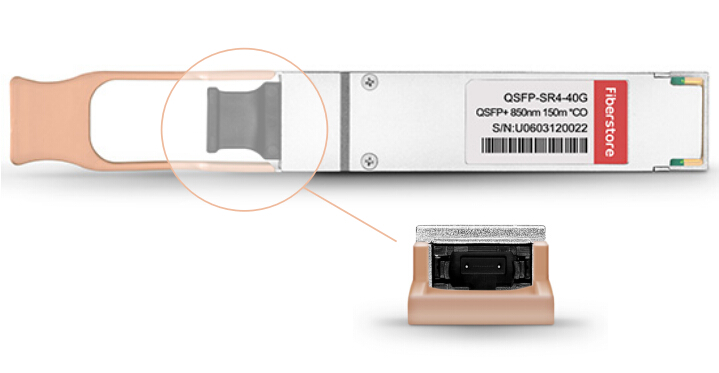
40G QSFP+ SR4 transceiver is a parallel fiber optic transceiver which means it uses four fibers for transmitting and four fibers for receiving at the same time. Designed with MTP/MPO interface, 40G QSFP+ SR4 transceiver is used together with multimode fiber, such as OM3 and OM4. Working on wavelength of 850 nm, 40G QSFP+ SR4 transceiver can support 40G fiber optic transmission with the link length up to 100 meters over OM3 fiber and 150 meters over OM4 fiber. For application, 40G QSFP+ SR4 transceiver can be used for 10G to 40G and 40G to 40G connections. Here is a figure of 40G QSFP+ SR4 transceiver for you.
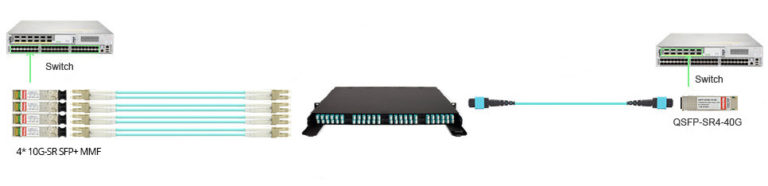
Since 40G QSFP+ SR4 transceiver uses four independent full-duplex transmit and receiver channels, the 40G optical signal can be split into four 10G optic signals. Therefore, we can increase the fiber count at the 10G distribution end to realize 10G to 40G connection. As the following figure shows, we can use 12f MPO trunk cable and fiber enclosure. Four 10G SFP+ SR transceivers are inserted into 10G ports on one side, while one 40G QSFP+ SR4 transceiver is inserted into 40G port on the other side. Then the four 10G SFP+ SR transceivers are connected with four duplex LC patch cables which are plugged into LC ports on the front side of MPO fiber cassette inside the fiber enclosure, and the 40G QSFP+ SR4 transceiver is connected with 12f MPO trunk cable which is plugged into MTP/MPO port on the rear of MPO fiber cassette. Finally, the whole optical link is completed.
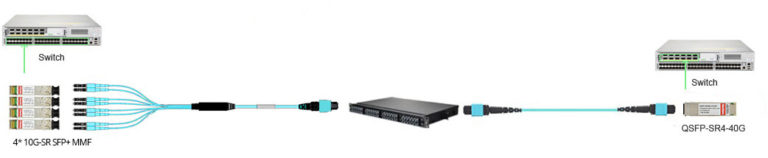
We can also use MPO to LC fanout and MTP fiber patch enclosure which includes MTP fiber adapter panels. This cabling solution is similar to the previous one, but the difference is that the four 10G SFP+ SR transceivers are connected with MPO to LC fanout which is plugged into MTP/MPO port on the MTP fiber patch enclosure. The scenario is shown in the following figure.
The following figure shows the simplest scenario for 40G to 40G connection. Two 40G QSFP+ SR4 transceivers are separately inserted into two 40G switches. Then the two 40G QSFP+ SR4 transceivers are connected by 12f MPO trunk cable.

We can also use MTP fiber patch enclosure to achieve better cable management and higher density cabling. The scenario is shown in the following figure. With the use of MTP fiber enclosure, cable management for 40G to 40G connection could be easier. A 48-port 1U rack mount MTP fiber patch enclosure includes up to four 12-port MTP fiber adapter panels with MPO MTP fiber optical adapters on it, here is a figure for you.

Designed with parallel transmission mode, 40G QSFP+ SR4 transceiver has a wide range of cabling applications with great flexibility. The cabling solutions mentioned above are just several commonly used ones. As for detailed cabling solutions for 40QSFP+ SR4 transceiver, it is suggested to depend on the practical applications and cabling environments. I hope after reading this article, you can learn more about 40G QSFP+ SR4 transceiver.
Oznake: 12f MPO trunk cable, MPO to LC fanout, MPO fiber cassette, MPO MTP fiber optical adapters, 40G QSFP+ SR4 transceiver
komentiraj (0) * ispiši * #
Overview of 100G Transceivers
srijeda , 17.05.2017.There was a time when 10G to 40G migration was a hot spot, and as the only available 40G transceiver, 40G QSFP+ has occupied the major position in the market. However, the pace of development has never stopped and the demand for higher speed data transmission keeps growing. And now, many data center managers set their sight on 100G Ethernet. As an important component in 100G optical links, 100G transceivers gradually gain great popularity among data center managers. But unlike 40G transceiver, 100G transceiver has several types, such as CFP/CFP2/CFP4, CXP and QSFP28. How much do you know about them? This article is going to give an overview of 100G transceivers.
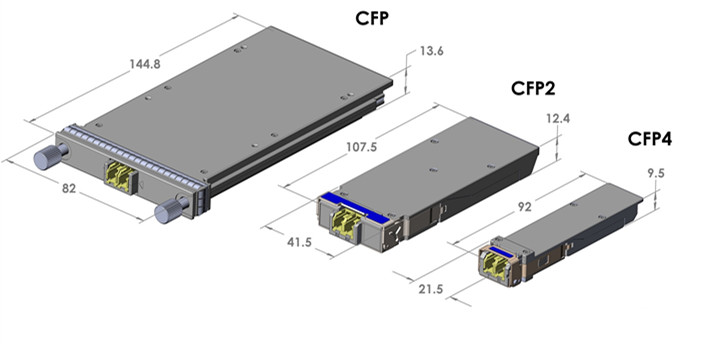
The letter “C” in CFP/CFP2/CFP4 stands for 100. The CFP transceiver is specified by MSA between competing manufacturers and it can support 100Gbps over both single-mode and multimode fiber. The electrical connection of a CFP uses 10 x 10G lanes in each direction (RX, TX) while the optical connection can support both 10 x 10G and 4 x 25G variants of 100G interconnects. With improvement in higher performance and higher density, CFP2 and CFP4 appeared. While electrical similar, they specify a form factor of 1/2 and 1/4 respectively in size of CFP. CFP, CFP2 and CFP4 modules are not interchangeable, but would be inter-operable at the optical interface with appropriate connectors.
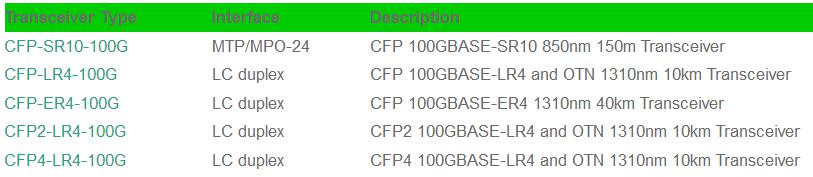
Here is a table for you which shows five typical transceiver types. We can get that CFP-SR10-100G is structured with 24-fiber MTP connector interface, so it can be used with multimode MTP 24 to MTP 24 100g trunk cable to support 100G optical links over short distance; designed with LC duplex interface, CFP-LR4-100G, CFP-ER4-100G, CFP2-LR4-100G and CFP4-LR4-100G are used with LC duplex patch cable to support 100Gbps data rate over long distance.
The CXP was created to satisfy the high-density requirements of the data center, targeting parallel interconnections for 12x QDR InfiniBand (120G), 100G, and proprietary links between systems collocated in the same facility. The CXP is 45 mm in length and 27 mm in width, making it slightly larger than an XFP. It includes 12 transmit and 12 receive channels in its compact package. This is achieved via a connector configuration similar to that of the CFP.
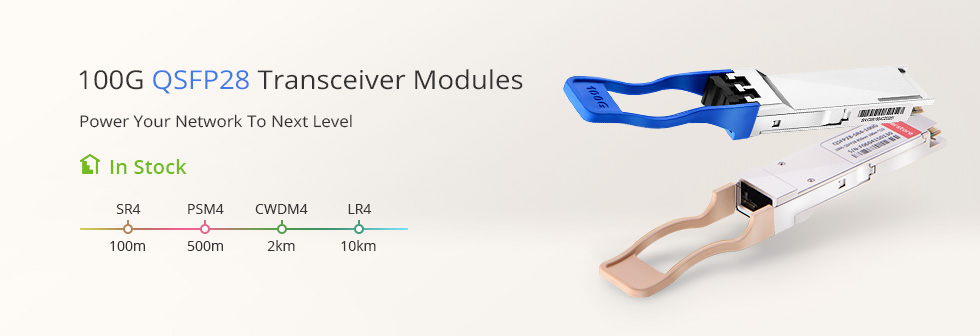
Similar to 40G QSFP+, 100G QSFP28 also offers four independent transmit and receiver channels, but each channel is capable of 25Gbps data rate for an aggregate data rate for 100Gbps. With an upgraded electrical interface to support signaling up to 25Gbps signals, the 100G QSFP28 makes it as easy to deploy 100G network as 10G networks. When compared to any of the other alternatives, the 100G QSFP28 increases density and decreases power and price per bit, but It has to noted that 100G QSFP28 has the same physical size as 40G QSFP+. Just like 40G QSFP+, 100G QSFP28 can be both deployed for short data transmission distance over multimode fiber and long data transmission distance over single mode fiber. For example, 100GBASE-PSM4 QSFP28 can be used with MTP single mode cable to support 100G data rate with link length up to 500 meters.
Now is the time of 100G Ethernet and 100G transceivers are indispensable to complete the 100G optical links. As there are various types of 100G transceivers available on the market, it is necessary to choose the best suitable one for your network deployment. FS.COM provides a complete range of 100G transceivers to meet the potential requirements. The prices of all their 100G transceivers are much more affordable than the similar products in the market. Furthermore, with the mature coding technology, they can be compatible with many major brands.
Oznake: 24-fiber MTP connector, MTP single mode cable, MTP 24 to MTP 24 100g trunk cable, single mode fiber
komentiraj (0) * ispiši * #
Decoding Outer Jacket of MTP/MPO Cable
petak , 12.05.2017.As high density cabling system has been widely deployed, MTP/MPO cable can be easily found in network deployment. But when you buy MTP/MPO cable in the online store, you must have been encountered with the situation where you not only have to select single-mode or multimode, 12 fibers or 24 fibers, but also have to consider the outer jacket of the cable which can protect the cable from damage. According to different cabling environment, there are different types of outer jackets, among which CMP, LSZH, CMR, CM are mostly used. How much do you know about them? This article will decode outer jacket of MTP/MPO cable and I hope it will be helpful for you when buying MTP/MPO cable.
CMP (plenum-rated) cable complies the IEC (International Electrotechnical Commission) 60332-1 flammability standard. It has passed stringent burn testing and is suitable for installation into air plenum spaces, where environmental air is transported. Typical plenum spaces are between the structural ceiling and the drop ceiling or under a raised floor. CMP cable is designed to restrict flame propagation no more than five feet as well as limit the amount of smoke emitted during the fire. In spite of this, for safety reason, any high-voltage equipment is not allowed in plenum space because the fresh air can greatly increase the danger of rapid flame spreading if the equipment is on fire. Because it has high fire-retardant, it usually costs more than other types.
The LSZH (low smoke zero halogen, also refers to LSOH or LS0H or LSFH or OHLS) has no exact IEC code equivalent. The LSZH cable is based on the compliance of IEC 60754 and IEC 61034. It is the newest in a family of ratings and it is sometimes refereed to as low toxicity cable. Containing no halogen type compounds that forms these toxic substances, LSZH cable gives of very little smoke and does not produce a dangerous gas/acid combination when exposed to flame. LSZH cable is suitable to be used in place where air circulation is poor such as aircraft, rail cars or ships. However, it is less fire-retardant than CMP.
CMR (riser-rated) complies IEC 60332-3 standards. CMR cable is designed to prevent fires from spreading floor to floor in vertical installations. It can be used when cables need to be run between floors through risers or vertical shafts. CM (in-wall rated) cable is a general purpose type, which is used in cases where the fire code does not place any restrictions on cable type. Some examples are home or office environments for CPU to monitor connections.
To select a suitable MTP/MPO cable for your network deployment, it is necessary to learn about the relevant details of cable ratings, which is as important as other factors. FS.COM provides high quality plenum and LSZH MTP/MPO patch cord at affordable prices.
Oznake: MPO patch cord, MTP patch cable supplier, CMP
komentiraj (0) * ispiši * #
