Introduction to HP ProCurve 2910al Switch Series
četvrtak , 12.10.2017.As telecom industry develops rapidly, the size of data center becomes larger and the data transmission speed becomes higher. And many data centers have moved to 40G and 100G. For small and middle size business, 10gb switch occupies a dominant market. HP switch, characterized by its high quality and low price, is popular with small data center network designers. This article will give an introduction to HP ProCurve 2910al Switch Series.
The HP ProCurve 2910al Switch Series consists of four 10gb ethernet switches, which are HP ProCurve 2910al-24G switch, HP ProCurve 2910al-24G-PoE+ switch, HP ProCurve 2910al-48G switch and HP ProCurve 2910al-48G-PoE+ switch. These switches can be deployed at enterprise edge and remote branch offices, converged networks, and data center top of rack. They are featured with IPv6 host which allows the switches to be managed and developed at the edge of IPv6 networks. Designed with up to four optional and flexible 10G ports (CX4 and/or SFP+), they can provide 10G connectivity. They are high-performance Gigabit access switches which can cost-effective and scalable solution for your network deployment. Here is a figure of HP ProCurve 2910al Switch Series for you.

Both HP ProCurve 2910al-24G switch and HP ProCurve 2910al-24G-PoE+ switch have twenty 10/100/1000 ports, four dual-personality ports one RJ45 serial console port and four 10G ports. While HP ProCurve 2910al-48G switch and HP ProCurve 2910al-48G-PoE+ switch have forty-four 10/100/1000 ports, four dual-personality ports one RJ45 serial console port and four 10G ports. With different port number, their switching capacities are different: 128 Gbps switching fabric with up to 95 Mpps for 24 port switch and 176 Gbps switching fabric with up to 131 Mpps for 48 port switch. For application in data center, different ports on the switch are connected with corresponding optical components.
- 10/100/1000 ports: All these ports have the “Auto MDIX” feature, which means you can use either straight-through or crossover twisted-pair cables to connect any network devices to the switch.
- Dual-personality ports: Each port can be used as either an RJ45 10/100/1000 port or as a mini-GBIC slot for use with mini-GBIC transceivers. By default, the RJ45 connectors are enabled. If a mini-GBIC is installed in a slot, it is enabled and the associated RJ45 connector is disabled and cannot be used. If the mini-GBIC is removed, the associated RJ45 port is automatically re-enabled.
- 10G ports: These ports provide connectivity for 10G speed though either copper or fiber optic media (CX4 and/or SFP+).
- For PoE+ switch, the RJ45 connector also supplies PoE+ power until a mini-GBIC is installed. That means the PoE+ power is turned off when a mini-GBIC is plugged in.
With 10/100/1000 ports, HP ProCurve 2910al Switch Series can be used for 1G to 1G connection. Just respectively plug two SFP transceiver modules into 1G ports on two switches, then connect the two SFP transceiver modules with a fiber optic cable. Besides, 10G to 10G connection can be accomplished by using 10G DAC cable. Therefore, it is very simply to utilize HP ProCurve 2910al Switch Series in data center. The following table shows supported fiber optic transceiver, optical fiber cable for HP ProCurve 2910al Switch Series.

In addition to providing cost-effective solution for small size business, a lifetime warranty offered by HP makes HP ProCurve 2910al Switch Series particularly a great choice. For transceiver and cable, you can go to FS.COM, which provides high quality compatible SFP, SFP+ transceiver, 10G SFP+ DAC cable and optical cable.
Oznake: 10gb ethernet switch, optical fiber cable, 48 port switch, optical cable
komentiraj (0) * ispiši * #
The Application of Fiber to the Desk (FTTD)
srijeda , 20.09.2017.As communication technology develops rapidly, the demand for higher bandwidth is increasing. To solve this problem, optical cable is widely used as the backbone of communications network cabling, especially in big data center. In recent years, projects like FTTH (Fiber to the Home) and FTTB (Fiber to the Building) are carried out to provide better services for customers. To future capitalize on the benefits of optical cable, Fiber to the Desk (FTTD) is recommended for enterprises, financial institutions and federal agencies, which need high security and high data transmission speed. This article will guide you to have a closer look at application of FTTD.
FTTD refers to the extension of the fiber optic infrastructure directly to user locations, just as the following figure show, optical cables are directly connected to desktops, laptops, or other communications equipment. FTTD can be used for virtual networks using thin clients and LAN networks with extended distances to workstations. It can satisfy the requirement for increasing bandwidth availability, moving large amounts of data at high transmission rates. In addition, it is able to bring service to locations where power is limited or unavailable as well as provide a more secure connection for organizations who are concerned about tapping or other security vulnerabilities.
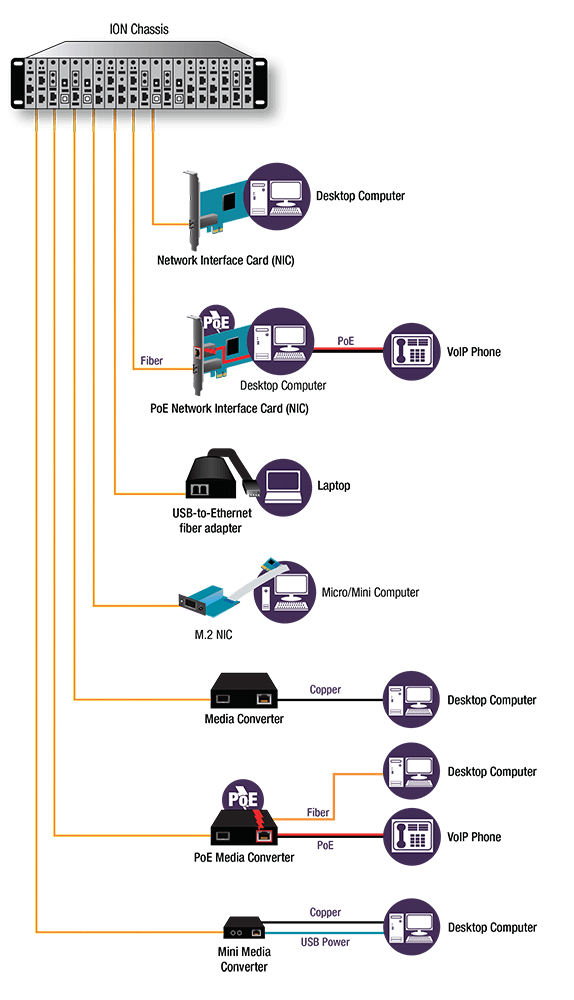
We know that RI45 Ethernet cable can also be used as transmission media. What makes optical cable superior to RJ45 Ethernet cable? This part will show you the advantages of using optical cable for FTTD project.
Optical cable is immune to electromagnetic interference (EMI) and radio-frequency interference (RFI), so it is more difficult for hackers to tap on optical cable. Besides, optical cable uses light that is completely shielded, so hackers would have to physically splice into the line, which is difficult to do and easily detected. While RJ45 Ethernet cable emits electromagnetic signals which allows hackers to read data from nearby without physically touching the lines. In contrast, optical cable is a more secure option for applications concerned with data security.
Optical cable is able to support higher data rates than any other cable type, with capacity to transmit up to 100 Gbit/s. As demand for higher bandwidth is ever-growing, optical cable has the absolute advantage. What’s more, connected with appropriate optics, the transmission distance of optical cable can reach dozen kilometers. Although higher grades of RJ45 Ethernet cables can transmit 10G data signals, they will only be able to do so over very short distances. Therefore, optical cable is the best choice for transporting higher speed and higher bandwidth signals over longer distances.
Optical cable used to be more expensive than RJ45 Ethernet cable. As demand has increased, manufacturing costs have dropped. Also, if properly designed, the FTTD project could be affordable. Apart from this, optical cable can ensure your network cabling can keep up with the growth in network traffic over time and upgrade your network to higher bandwidth in the future without recabling. Considering the cost of cabling, this can be a huge advantage. Though the initial cost of fiber equipment may be slightly higher than copper, the benefits realized can save organizations significant cost in the long term.
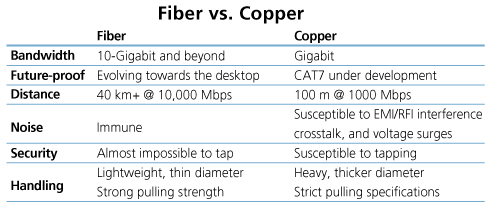
Optical cable Vs. RJ45 Ethernet cable
FTTD is a high-bandwidth solution that expands the traditional fiber backbone system by running fiber directly to desktops. FTTD is a horizontal wiring option that pushes the available bandwidth beyond 10G. It is an intriguing, underestimated and overlooked way to create a beneficial system that is expandable and performance-driven.
Originally published at: http://www.fiber-optical-networking.com/application-fiber-desk-fttd.html
Oznake: FTTD, optical cable, rj45 ethernet cable, PoE media converter
komentiraj (0) * ispiši * #
