Characteristics of 10GBASE-T Technology
srijeda , 08.11.2017.The rapid development of telecom technology is driving the increasing need for higher bandwidth in data center. In recent years, 10GBASE-T technology, which uses twisted-pair copper cabling and RJ45 interfaces, has been utilized by many data center managers. When it comes to 10GBASE-T, we firstly think of Ethernet network cable, such as Cat6 UTP cable and Cat6a cable which support 10G speed over 55 meters and 100 meters respectively. They are cheap and easy to run in data center. And this is just one of the most prominent characteristics of 10GBASE-T technology. This article is going to give a detailed introduction to characteristics of 10GBASE-T.
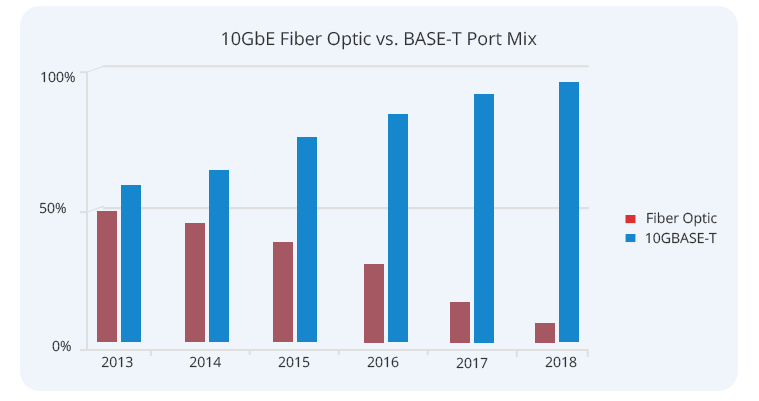
In data center, fiber optics also generally gain popularity because of their high speed and low latency. Many data center managers choose to use a combination of Direct Attach Copper (DAC) cables for short distances (up to 7 meters for Top-of-Rack connections) and fiber optic cabling for longer distances (for End-of-Row connections) to fulfill the migration to 10GbE networks. However, the costs associated with a Top-of-Rack switch and expensive cabling and optics limited the widespread adoption, especially in data centers where 1GbE is already broadly deployed. On the contrary, 10GBASE-T is backward compatible with 1000BASE-T, and it can be deployed in existing infrastructures that are cabled with Cat6 and Cat6a or greater cabling, helping data center managers to keep costs down while offering an easy migration path to 10GbE. Therefore, 10GBASE-T technology is extensively used. From the chart below, we can clearly see the growing trend of 10GBASE-T.
Reach: DAC cables support 10Gbps over very short distances, while 10GBASE-T technology can reach much longer reach with Cat6a cable, up to 100 meters. This makes 10GBASE-T cabling with Cat6a the best universal solution for 10GbE requirements in today’s data centers.
Backward compatibility: 10GBASE-T is backward compatible with 1000BASE-T, so it can work with existing structured cabling system. Unlike SFP+ cabling, a 10GBASE-T connection can auto-negotiate and auto-select the proper port speed when plugged into a GbE port. This gives data center managers much flexibility in cabling system.
Installation: Fiber optic cable is easily damaged, while Cat6 cable and Cat6a cable are easy to manage. Even if you want to DIY your own cable length, you just need bulk Ethernet cable, crimping tools and RJ45 connectors. As RJ45 connectors are compatible with existing 1GbE infrastructure, the installation of Cat6 and Cat6a cable is easy.
Power: When 10GBASE-T standard was released at the beginning, 10GBASE-T PHYs consumed too much power which limited its widespread adoption. With process improvements, both the power and cost of the latest generation of 10GBASE-T PHYs have reduced.
Cost: Fiber optic cable is more expensive than Ethernet network cable, and usually fiber optic cable is used for long transmission distance application. While Cat6 cable and Cat6a cable are low cost, which can provide cost-effective and easy-to-use solution for 10GBASE-T short distance network deployment.
10GbE has been the mainstream of telecom data center right now. The low cost and easy installation of 10GBASE-T makes it widely applied. In addition, 10GBASE-T provides investment protection via backward compatibility with 1GbE networks. On the market, there are not only Cat6 cable and Cat6a cable for 10GBASE-T cabling, but also some other 10GBASE-T products, such as 10GBASE-T switch and 10GBASE-T adapter. These simplifies data center networking deployments by providing an easier path to 10GbE infrastructure. These characteristics of 10GBASE-T will help drive 10GBASE-T to a prominent place in the data center.
Originally published at: http://www.fiber-optical-networking.com/characteristics-of-10gbase-t-technology.html
Oznake: cat6 utp cable, 10gbase t rj45, 10Gbase-T
komentiraj (0) * ispiši * #
Compatible Issues of Optical Transceiver
srijeda , 01.11.2017.When deploying the cabling system, sometimes you may encounter such situation when there is already brand A switch, but you got brand B optical transceiver. Then, the compatible issue is what you most worry about. Just like the following figure shows, Cisco SFP-10G-SR transceiver definitely works well when plugged into 10G SFP+ port on Cisco switch, so does HP SFP-10G-SR transceiver with HP switch. But when you plug Cisco SFP-10G-SR transceiver into 10G SFP+ port on HP switch, will the link perform well? The answer is “Yes”. However, not all cases that mix brands will get the answer “Yes”. There are still some important aspects that you have to take into consideration. This article will focus on compatible issues of optical transceiver.

To ensure the whole link works at high performance level, before you use mixed-brand optical transceiver and switch, there are some important aspects of optical transceiver that you must think about.
Standard
We know that optical transceiver has different standards, such as 10GBASE-SR, 10GBASE-LR, 10GBASE-ER, 10GBASE-ZR, 10GBASE-T, and so on. Different standards are applied to different network infrastructure. And you have to pay attention that you use optical transceivers of the same standard at each end, for example: both sides with 10GBASE-SR SFP module. You can’t connect 10GBASE-SR SFP module with 10GBASE-T SFP+ transceiver. Otherwise, you have to undertake the risk of link failure.
Port
Usually, there are multiple ports on the switch. Take 10G switch for example, it often has about 24 SFP ports and 2 10G SFP+ ports. And some may have 10G RJ45 port. It is not hard to understand that you plug SFP module into SFP port, 10G SFP+ module into 10G SFP+ port, and plug 10G copper SFP into 10G RJ45 port. But in fact, some SFP modules can work in SFP+ port, only performing at 1G speed. While 10G SFP+ will only work for 10G SFP+ port. Therefore, remember to check if you plug the optical transceiver into the right port on the switch.

Wavelength
Optical transceiver works at a certain wavelength, such as 850nm, 1310nm or 1550nm. It is essential that the wavelength of the optical transceivers on both end matches. Because a transceiver working at 1310nm will not talk to a transceiver working at 850nm. The wrong wavelength may cause loss and degradation along the optical link. So, make sure your transceivers will work at the same wavelength.
Cable Type
Optical transceiver must be used with corresponding fiber optic cable. For example, 10G SFP+ transceiver made for multimode fiber isn’t going to work well with singlemode fiber. Besides, though the transceiver is used with multimode fiber, OM3 or OM4 may have different results. But the most important thing is that you have to choose the cable according to the standard of the optical transceiver as well as its interface.
From the above content we can conclude that, in most cases, when connecting two optical transceivers of different brands, the optical link will work well as long as you use optical transceivers with the same standard and wavelength, plug it into the right port and choose the suitable cable type.
Oznake: optical transceiver, 10Gbase-T, sfp 10g sr transceiver, 10gbase t sfp+ transceiver
komentiraj (0) * ispiši * #
