Weapons 2nd Rebirth

05.01.2005., srijeda
A evo i tog OICW-a
|
Sastavio sam fakin' tekst i nikak da ga prevedem, pa evo vam za sad na Engleskom. Kad završim prijevod objaviti ću i njega. :)= Heckler-Koch XM-29 SABR(Selectable Assault Battle Rifle) / OICW (Objective Individual Combat Weapon) assault rifle (USA) Caliber: 5.56 mm NATO (KE) and 20x85mm (HE) Action: Gas operated, rotating bolt (KE), unknown (HE) Overall length: 890 mm Barrel length: 250 mm (KE) 460 mm (HE) Weight: ca 5.5 kg empty; ca 6.8 kg loaded Magazine capacity: 20 or 30 rounds box (KE) and 6 rounds box (HE) The history of the one of the most ambitious projects in the history of small arms, known as the OICW, or the Objective Individual Combat Weapon, began late in the 1986, when the US Army Infantry School at Ft. Benning published a military paper, named "Small Arms System 2000" (SAS-2000). Despite the current trends towards the caseless and fleschette ammunition and appropriate weapons, researched and developed under the ACR program (see HK G11 and Steyr ACR entries for some details), this paper stated that the conventional small arms already reached its technological peak, and the only way to increase the hit probability in the small arms is to introduce a weapon that will fire explosive and fragmentation warheads, combined with the smart fusing and sighting / aiming technologies. While the most small arms research during the late 1980s in the USA was conducted under the ACR program, the idea first developed in the SAS-2000 was supported by another US military paper, published in 1989 by the US Army TRADOC (Training & Doctrine) center. This paper, called "The Small Arms Master Plan" (SAMP), requested for a family of infantry "Objective" weapons, namely the Objective Individual Combat Weapon (OICW), Objective Personal Defense Weapon (OPDW), and the Objective Crew Served Weapon (OCSW). The SAMP stated that such weapons must utilize the latest developments in computers and visual technologies, as well as in the small arms, and combine both high explosive warheads and traditional bullets fire capabilities in a single weapon, that should be fielded circa 2000. Of cause, the timelines and most of the weight and cost requirements set in this paper looked unrealistic from the start, but the development of the Objective weapons began in the early 1990s. During the early stages of research and development in the mid-1990 one out of the two teams was selected as a winner for further development contract. This team is lead by the US based Alliant Techsystems corporation (ATK), with the Heckler-Koch (Germany), Brashear and the Omega companies (both of USA) as the other team members. The ATK is responsible for system integration, and also develops the 20mm Air Burst munitions; HK is responsible for both the 5.56mm rifle and the 20mm grenade launcher; Brashear works on the sighting equipment and Omega provides the training means. The resulting weapon was type-classified by the US Army as the XM-29 circa 2002, and is scheduled to enter the service during the year 2008 in limited numbers. It will be then consequently upgraded with the new technologies then available. Present plans for fielding the M-29 are to issue four units per one infantry squad of 9 men. Early in the 2002 the XM-29 test weapons were successfully tested with the newest 20mm HEAB (High Explosive Air Bursting) munitions, which will be a major "kill factor" for the M-29 weapon. At the same time the "kinetic energy" part of the XM-29 was type-classified as the XM-8 light rifle, and, in the near future, could possibly replace the current Colt M4 carbines as a standalone compact conventional small arms. XM-29 OICW Description. The XM-29 is a combination weapon, which has the 20mm semi-automatic, magazine fed grenade launcher as its primary part, and the 5.56mm compact assault rifle as its secondary part. Both parts are assembled into the single one-man portable unit, with the addition of the target acquisition / fire control system (TA/FCS), which is an essential part of the whole system. The XM-29 will become an integral part of the future Land Warrior system, capable of communicating with the other parts of this system, including the tactical computers and helmet-mounted displays. The grenade launcher is capable to fire in semi-automatic mode only, and is gas operated. It has a bullpup layout with the detachable box magazine located in the butt of the weapon. The rifled barrel is used to launch the 20mm grenades up to the 1000 meters range with good accuracy. In the standard configuration most of the fire controls for the grenade launcher part are located on the rifle part, including the single trigger for both firing modules. It is quite possible, however, that the separate stock will be developed for the grenade launcher part, so it will be possible to use it without the rifle part attached. The launcher has the provisions for the TA/FCS system to be mounted on its top, and the appropriate interfaces, so the data provided from the TA/FCS can be used to program the 20mm grenade fuses. These fuses, used for the 20mm HEAB ammunition, has multiple mode of detonation, including the direct impact mode and the Air Burst mode. In the latter mode the fuse is pre-programmed to explode the warhead at the preset range, which is calculated during the flight by counting the number of the grenade rotations. This allows do defeat targets without the direct impact, using the blast and fragmentation effect of the high explosive warhead. This is a major advantage over the present small arms, which in most cases require the direct hit on the target to be effective, as it allows for greater aiming errors, and also makes possible to defeat targets in defilade, like the trenches and so. The high explosive warhead also has the advantage of not being dependent on its velocity to be effective, so unlike with the bullets, its effectiveness does not decreased with the increase of range. The disadvantages of this system is the extreme complexity of the electronic fuses, which results in the high price of a single round of ammunition. The present plans stated that the one HEAB round must cost about US $25, and it is still to be seen which will be an actual price when the M29 system will be fielded. It is interesting that the present design of the HEAB ammunition actually has two small HE warheads at the front and at the rear of the projectile, with the electronic fuse module located between them. While the HEAB is considered a primary round for the 20mm grenade launcher, it is entirely possible do develop a low cost, direct hit only anti-armour 20mm round with Shaped Charge warhead, which will be effective against lightly armored vehicles (APC, MICV and alike) and various hardened targets. The rifle, or "kinetic energy" part of the XM-29 system, on the other hand, is a fairy conventional, short-barreled assault rifle, derived from the Heckler-Koch G36 assault rifle. The basic "rifle" part of the XM-29 has no buttstock and no own sights, and thus can be used separately from the whole system only as emergency, personal defense weapon. While being mounted to the whole system, it can be used for a close quarters work, both defensive or offensive (the 20mm grenade launcher has it minimum range of fire of about 50-100 meters), or as an low-cost, low intensity medium range offensive weapon. Most of the XM-29 system controls are built into the "rifle" part, around the trigger guard. The target acquisition / fire control system (TA/FCS) is the most expensive and complicated unit of the whole system, since it must combine day and night vision capabilities, laser rangefinding unit, ballistic computer and various interfaces to the grenade launcher and external systems. It is used to find the targets in any light and weather conditions, determine the range to the target, calculate and display the aiming data, so the grenade or bullet could be fired to the desired point of impact, and then supply the data to the grenade launcher, so the range could be preset into the grenade fuse. In the case of damage to the TA/FCS the 20mm grenade launcher still can be used in the direct impact mode, as well as the rifle part of the system. The current research and testing showed that the XM-29 can be up to 500% more effective than the present small arms, but it is still to be seen if all the requirements will be met in the resulting system, especially regarding to the reliability of electronic components, weight, and, at last but not at least, the unit price. UPDATE: 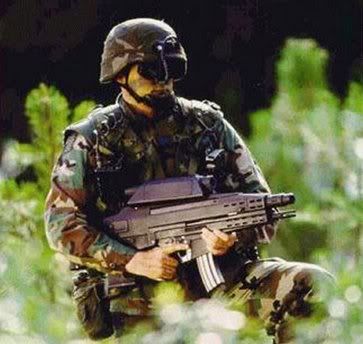 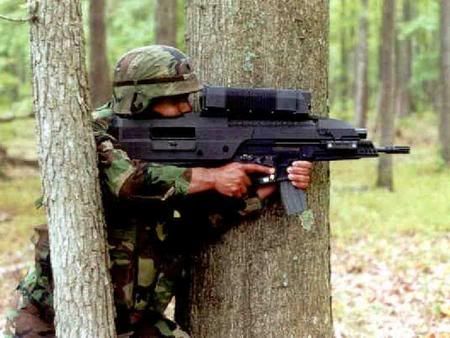 |
04.01.2005., utorak
Evo i opisa hidrogenske bombe u detalje :)= (na Engleskom!)
|
HYDROGEN BOMB The HYDROGEN BOMB, or H-BOMB, weapon whose enormous explosive power results from an uncontrolled, self-sustaining chain reaction in which isotopes of hydrogen combine under extremely high temperatures to form helium in a process known as nuclear fusion (q.v.). The high temperatures that are required for the reaction are produced by the detonation of an atomic bomb. A thermonuclear bomb differs fundamentally from an atomic bomb in that it utilizes the energy released when two light atomic nuclei combine, or fuse, to form a heavier nucleus. An atomic bomb, by contrast, uses the energy released when a heavy atomic nucleus splits, or fissions, into two lighter nuclei. Under ordinary circumstances atomic nuclei carry positive electrical charges that act to strongly repel other nuclei and prevent them from getting close to one another. Only under temperatures of millions of degrees can the positively charged nuclei gain sufficient kinetic energy, or speed, to overcome their mutual electric repulsion and approach close enough to each other to combine under the attraction of the short-ranged nuclear force. The very light nuclei of hydrogen atoms are ideal candidates for this fusion process because they carry weak positive charges and there is thus less resistance to overcome. The hydrogen nuclei that combine to form heavier helium nuclei must lose a small portion of their mass (about 0.63 percent) in order to "fit together" in a single larger atom. They lose this mass by converting it completely into energy, according to Albert Einstein's famous formula: E = mc2. According to this formula, the amount of energy created is equal to the amount of mass that is converted multiplied by the speed of light squared. The energy thus produced forms the explosive power of a hydrogen bomb. Deuterium and tritium, which are isotopes of hydrogen, provide ideal interacting nuclei for the fusion process. Two atoms of deuterium, each with one proton and one neutron, or tritium, with one proton and two neutrons, combine during the fusion process to form a heavier helium nucleus, which has two protons and either one or two neutrons. In current thermonuclear bombs, lithium deuteride is used as the fusion fuel; it is transformed to tritium early in the fusion process. In a thermonuclear bomb, the explosive process begins with the detonation of what is called the primary stage. This consists of a relatively small quantity of conventional explosives, the detonation of which brings together enough fissionable uranium to create a fission chain reaction, which in turn produces another explosion and a temperature of several million degrees. The force and heat of this explosion are reflected back by a surrounding container of uranium and are channeled toward the secondary stage, made up of tritium or other fusion fuel. The tremendous heat initiates fusion, and the resulting explosion of the secondary stage blows the uranium container apart and causes it too to fission, thus contributing to the explosion and producing fallout (the deposition of radioactive materials from the atmosphere) in the process. (A neutron bomb is a thermonuclear device in which the uranium container is absent, thus producing much less blast but a lethal "enhanced radiation" of neutrons.) The entire series of explosions in a thermonuclear bomb takes a fraction of a second to occur.A thermonuclear explosion produces blast, light, heat, and varying amounts of fallout. The concussive force of the blast itself takes the form of a shock wave that radiates from the point of the explosion at supersonic speeds and that can completely destroy any building within a radius of several miles. The intense white light of the explosion can cause permanent blindness to people gazing at it from a distance of dozens of miles. The explosion's intense light and heat set wood and other combustible materials afire at a range of many miles, creating huge fires that may coalesce into a firestorm. The radioactive fallout contaminates air, water, and soil and may continue years after the explosion; its distribution is virtually worldwide.Thermonuclear bombs can be hundreds or even thousands of times more powerful than atomic bombs. The explosive yield of atomic bombs is measured in kilotons, each unit of which equals the explosive force of 1,000 tons of TNT. The explosive power of hydrogen bombs, by contrast, is frequently expressed in megatons, each unit of which equals the explosive force of 1,000,000 tons of TNT. Hydrogen bombs of more than 50 megatons have been detonated, but the explosive power of the weapons mounted on strategic missiles usually ranges from 100 kilotons to 1.5 megatons. Thermonuclear bombs can be made small enough (a few feet long) to fit in the warheads of intercontinental ballistic missiles; these missiles can travel almost halfway across the globe in 20 or 25 minutes and have computerized guidance systems so accurate that they can land within a few hundred yards of a designated target.Edward Teller and other American scientists developed the first hydrogen bomb, which was tested at Enewetak atoll on Nov. 1, 1952. The U.S.S.R. first tested a hydrogen bomb on Aug. 12, 1953, followed by the United Kingdom in May 1957, China (1967), and France (1968). During the late 1980s there were some 40,000 thermonuclear devices stored in the arsenals of the world's nuclear-armed nations. This number declined during the 1990s. The massive destructive threat of these weapons has been a principal concern of the world's populace and of its statesmen since the 1950s. |
Evo fotke hidrogenske bombe i njene "gljive" i još nešto :)=
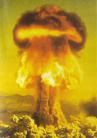
Kak je to izgledalo u početku: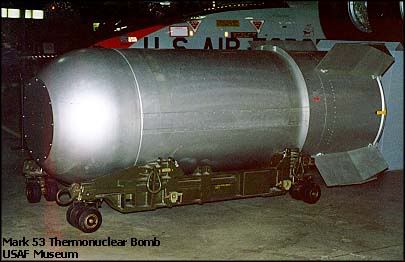 i The "Gljiva" : 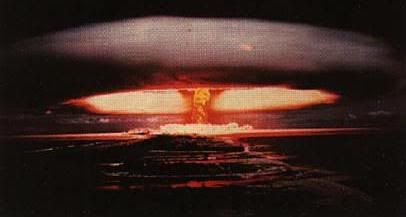 Prva Hidrogenska bomba testirana na otočiću Eniwetok u Tihom oceanu 1952. godine: 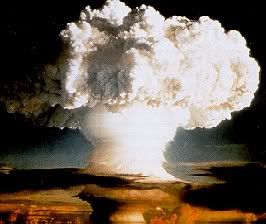 Inače, kreator hidrogenske bombe je Edward Teller (1908.-2003.) , evo i njegove slike: 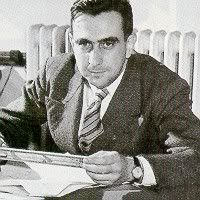 |
03.01.2005., ponedjeljak
Izbori u lijepoj našoj ....
 Jao kako se tu sere . fakat ne vjerujem , brijem da je pol tog namješteno ... nekak mi je presumnjivo da Mesiću fali jebenih 1% (ni tolko) da pobjedi u prvom krugu, a i dogodilo se nešto čudno sa Kosoricom i Mikšićem , koliko je meni poznato Mikšić je imao cca 20% 2 sata prije ponoći a Kosorica cca 17% i sad odjednom za ponoć se oni zamjene doslovce. Ma joj , ne znam šta da kažem , tu prste 100% ima HDZ jer oni su oduvjek bili podli , a svatko zna da Hrvatska ima vrlo visoku stopu korumpiranosti u svijetu... Eh sad sam se nečeg sjetio , zanimljivo mi je da su u principu za HDZ glasali (mislim na stranačke izbore) ljudi sa vrlo niskim stupnjem obrazovanja , dok su za npr. SDP i ine (lijeve) stranke u glavnom glasali ljudi sa visokim obrazovanjem , čini mi se da je ista stvar i kod ovih izbora. Kak mi je diglo tlak ono jebeno prepucavanje Mesića i Kosorice i ona glupa pašteta, i kak su zadrto zvučali samo kad su došli u stožer od Kosorice , mislim ona nešto kaže i neki debil iza nje se počne derati Jadranka, Jadranka , pa jebote ko da ste na jebenom selu a ne na nacionalnoj televiziji, moram priznat da se Mesić oke držao i da ju je fino odjebao sa onim smješkom , ona njemu neš sere , a on se samo nasmije.. hehe. A ugh , onaj Mikšić mi je nekak malo sumnjiv , sad kad su izbori sam se odjednom pojavi i glumi nekog dobričinu , ja bi reko da su to sve same pare , ko uopće zna kak se on u americi obogatio, tip čak i nije tako loš , svaka mu čast sam si je platio kampanju i obećaje nova radna mjesta , ali sve je to jebeni trik , on će nam tu otvoriti neke SVOJE tvornice i još više se obogatiti , sad tip ima para i misli da može imat svoju državu, di je bio sve ove godine , mogao je doći za vrijeme rata sa tim svojim parama, onda bi sigurno više koristilo.. ma neću sad više o tome ... aj bok. |
Fak škola
|
Upravo sam skužio da imam školu sutra i to mi je poremetilo planove (grrr.... fuj novi zakon o sskolskim praznicima) , cijelo vrijeme sam mislio da imam jos jedan tjedan praznika , damn! Tak da ću opet otkazati opis OICW-a , a nadam se da ću ga napisati prvim danima ovog tjedna. Nisam na kavi bio vec par dana, ni na pivi i želim sutra otić a imam jebenu školu , popodne (mogu markat ali imam previše izostanaka, a polugodište nije još gotovo) i eto sad gledam Star Trek i trebao bih ić spavati a ne mogu i neću a sutra ću biti ko zombi jer sam se taman naviknuo na buđenje oko 15h .... i da Sretna Nova Godina .. |