Marketing
Talk About 2.5G And 5G
Network technology is developing rapidly. To keep up with the trend, data centers are required to upgrade constantly, from 10G to 40G, 40G to 100G and even 100G to 400G. However, for some small business data centers with 1G infrastructures, directly migrating from 1G to 10G is a little fast. Is there any slower Ethernet standards to fill the gap between 1G Ethernet and 10G Ethernet speeds? The answer is Yes—2.5 Ethernet and 5G Ethernet. This article will talk about 2.5G and 5G.
The physical (PHY) layer transmission technology of IEEE 802.3bz is based on 10GBASE-T, but operates at a lower signaling rate. By reducing the original signal rate to
1/4 or
1/2, the transfer rate drops to 2.5 or 5 Gbit/s, respectively. The spectral bandwidth of the signal is reduced accordingly, lowering the requirements on the cabling, so that 2.5GBASE-T and 5GBASE-T can be deployed at a cable length of 100 meters on unshielded Cat5e cable and Cat6 cable, respectively. The following figure shows the comparison of twisted pair based Ethernet technologies.
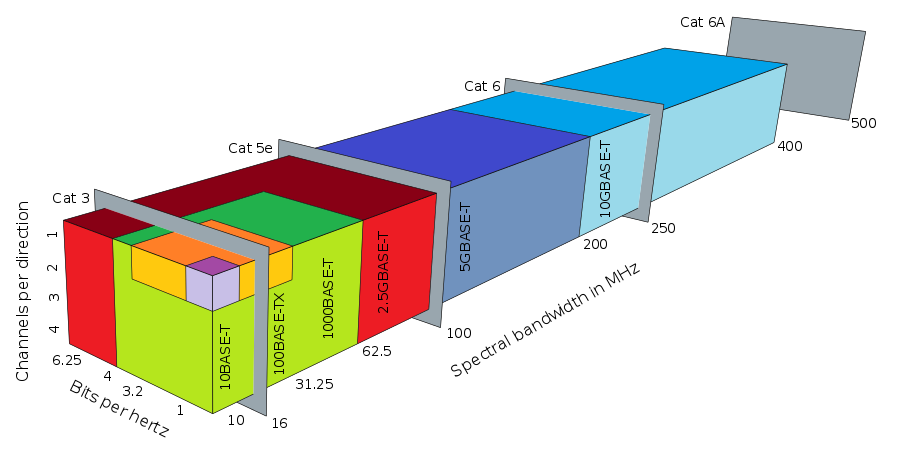
As 2.5G and 5G Ethernet standards came out after 10G Ethernet standard, there are mixed reviews for them. This part will focus on cons and pros of 2.5G/5G Ethernet standards.
When 2.5G Ethernet and 5G Ethernet standards came out, many people didn’t think much of them. They commented that:
- 5GBase-T and 5GBase-T are more going to be used for wifi rollouts. And they are pretty much strictly for enterprise wireless deployments.
- 10GbE is getting pretty cheap. Lots of new desktop motherboards now have 10G NICs inside them and the premium seems to be less than $100 too, which isn't too bad. What's missing is a bunch of 10G home switches and routers.
- As for the availability, the 10G has 2 models out while the 2.5G and 5G are both "coming soon". Due to the economies of scale and the penetration, 10G already has IMO. While 2.5G and 5G will never be widely adopted or supported.
- There are not that many chip sets that support 2.5G Ethernet and 5G Ethernet yet as they really only got finalized. Also, most cards that support them right now also support 10Gbe.
What exists is reasonable. One estimate is that there are 70 billion meters of Cat5e and Cat6 cabling have been sold between 2003 and 2014. With such a significant amount of existing infrastructure at stake, it's hardly surprising that most enterprises want to extend the existing cabling, component and equipment investments in the standard Ethernet wireless closet. Therefore, it is not difficult to find that 2.5G Ethernet and 5G Ethernet standards have their advantages.
- Cat5 and Cat6 cabling can’t support 10G Ethernet up to 100 meters, but they will be able to support the emerging 2.5Gbps and 5Gbps standards, thereby preserving the value of the existing copper cable plant.
- Adopting new 2.5G and 5G can satisfy the need of increasing data rates of wireless networking. The new 802.11ac Wi-Fi standard increases wireless bandwidth, supporting Ethernet speeds of 1.7 Gbps to 2.5 Gbps. With the coming of the next generation of wireless networking, 802.11ac Wi-Fi Wave 2, wireless network speeds could increase to as high as 6.8 Gbps.
- Besides the need from the Wi-Fi industry, a 2.5G/5G version will also aid in other applications such as enterprise infrastructure, cellular Wi-Fi offloads, small cells, security cameras, multiple industrial uses and PoE technology.
- These two new Ethernet standards have plenty of attributes to ensure success, such as ease of use, backward compatibility, faster speeds without requiring a cable upgrade, incremental speed upgrades, multi-vendor interoperability, not to mention optimized cost and performance.
From the above content, we can conclude that 2.5G/5G Ethernet standards have both pros and cons. For those who want to upgrade cabling system to 10G, 2.5G/5G is not useful. While for small business and home network, 2.5G/5G is a cost-effective solution. No matter what your cable plant is, choosing a suitable migration path is the most important thing.
Originally published at: http://www.fiber-optical-networking.com/talk-about-2-5g-and-5g.html
Post je objavljen 25.10.2017. u 08:12 sati.