Ethernet Cable vs. Telephone Cable: Which Is Your Option?
25.10.2017.Both Ethernet cables and telephone cables are good choices for home network. How to choose wisely for your home networking at the least cost but high performance? This question involves various factors, the sizes and types of files you will be transmitting, your networking planning, budget and Internet connection sharing.
Most of us hold the view that it is only Ethernet cables can achieve home network connectivity, and this assertion is incorrect. Telephone cables can also operate a network through frequency division multiplexing, which means that the data transmitted over the lines runs at a different frequency than the voice traffic. When you use the phone, data can be sent at the same time via a phone line network as well as fax can be sent via the Internet. Since the data sent by a modem is modulated to the same frequency as voice traffic, it is unnecessary to use the dial-up Internet.

Telephone cable is one of the merits of a phone line network. In the phone line network system, the telephone cable is in place already and thus it is redundant for you to connect them. You can connect a computer to the network in any room with a phone jack.
Ethernet cable, also called network cable, is the most common type of cable used for home and enterprise network connectivity. Network cables can be divided into several types according to different standard of classification. They can be divided into shielded twisted pair and unshielded twisted pair. Ethernet cables are also rated by Category, Cat5e, Cat6 and Cat6a are the most common types. Cat5e cable support 1G network while Cat6 and Cat6a support 10G network connectivity respectively. According to the different polish type, they can also be categorized as UPC and APC. Those three kinds of cabling relies on the twisting of the pairs to reduce signal loss and has terminating connectors called RJ45s, which are similar to but slightly larger than the RJ11 phone connectors.

For high-speed transmission, Ethernet cable is more appropriate for long-haul transmission. Phone networks originally operated at 1 Mbps to 2 Mbps, but newer networks can run at speeds up to 10 Mbps. However, 10 Mbps might be considered a disadvantage to this type of network since even with the newest technology, network speed is capped at 10 Mbps. The data rates after Cat6 (Cat6 is including) all can be up to 10 Gbps. If your demand only limits at some near area within short distance, and then telephone cable is your choice.
Relatively speaking, network patch cables are more expensive than telephone cables. But they do worth the money. If you have a tight budget, telephone cable would be a good choice as well. Merits of Cat6 cable (network cabling) are the availability of premade cables, the ability to run the Ethernet cable anywhere you want to put a computer and the speed of the data transfer. However, you need specialized equipment, in the form of hubs or switches, to make use of this cabling. These hubs and switches cost significantly more than the basic telephone connection equipment and can run in the hundreds of dollars.
Both telephone cable and Ethernet cable are of high security. But some kinds of network cable are fragile in certain circumstance, such as moist, squirrels in forests, truck with high clearance and etc. And thus, telephone cable is more secure than network cable.
This article mainly discussed about telephone cable and Ethernet cable, and made a comparison in terms of transmission speed, budget and security. The choice between Ethernet cable and phone cable comes down to your need for speed and your available budget at large extent.
Oznake: network patch cable, ethernet patch cable, telephone cable, cat5e cable, cat6 cable
komentiraj (0) * ispiši * #
Cat6 Vs. Cat7 Cable: Which Is Optimum for A New House?
16.10.2017.It is generally acknowledged that build a new house is not a simple task, especially for setting up a new network in the new house. Cat5 network cable seems lags behind a lot in the long run of network cables. For future proofing network cables, both Cat6 and Cat7 Ethernet cables are good choice. Allodoxaphobia would occur under this occasion for most Ethernet users about the optimal one. This article would put emphasis on comparing the difference between Cat6 and Cat7 network cable, and guiding you to choose a better one for a new house in the following four aspects.
Specification is paramount to network cables, so do the Cat6 and Cat7 Ethernet cables. Cat7 Ethernet cable features even more strict specifications for crosstalk and system noise than Cat6 Ethernet cable. Shielding has been added for individual wire pairs on the Cat7 cable. Besides, CAT 7 is backwards compatible with traditional Cat5 and Cat6 Ethernet. And Shielding has been added for individual wire pairs on the Category 7 cable. Xmultiple's UltraJAX connectors are designed specifically for these high speeds with not contact pins and a printed circuit board with contact pads integrated into the RJ45 style housing.
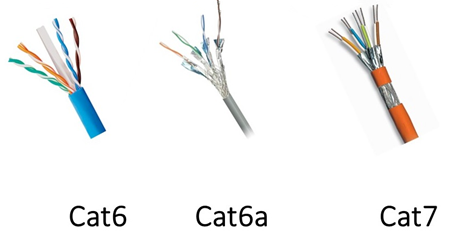
For setting up a network in a new house, it is necessary for us to take the prevalent network speed in the years ahead. Will home machines will be able to actually use 10G even in the next 10 years? Years ago, people did to put in cat6 rather than cat5e. They believed the market went from 1G which runs fine on 5e directly to 10G which requires cat6a or cat7. All those people who thought they would "save" money in the future found out they wasted it. The now run 1G over their very expensive (at install time) cat6 cable and if they ever want to go faster will have to replace it just as if they had put in cat5e.
Cat6 cable standard provides performance of up to 250 MHz while Cat7 cable is rated for transmission frequencies of up to 600 MHz. The maximum cabling length of Cat6 network cable is 100 m. Cat7 has been designed as a standard for Gigabit Ethernet over 100 m of copper cabling.

With current SSD drives pushing past 500Mbytes which is around a 50% improvement in about a year and a half, 4k tv's needing around 10gbs because you never get max bandwidth, going to be throwing spam about your house. As far as I’m concerned, I would lean towards cat7a if there is only a few hundred pounds difference. Both Cat7 and Cat6 cables are relatively expensive than the Cat5, Cat5e. Relatively speaking, Cat7 cable is more expensive than Cat6 cable. If you cannot afford both of them, and then Cat5e would also be a good choice for 10G network.
According to the trend of network development, Cat7 cable is more appropriate for setting up a new house. The Cat7a network cable is particularly suitable for the new house. Under 40 Gigabit Ethernet, it will work up to 50 meters and under 100 Gigabit Ethernet, it is possible up to 15 meters. If you are in a tight budget, Cat6 and Cat5e cable would also be good choices.
Oznake: cat6 cable, cat6 ethernet cable, Cat7, Cat7 cable, cat7 vs cat6, cat6 vs cat7
komentiraj (0) * ispiši * #
